Table of Contents
Spinal decompression and inversion tables both aim to take pressure off the spine, but they are not the same thing. An inversion table uses your body weight and gravity by tipping you upside down, which applies a general, whole-spine stretch. Spinal decompression uses a computer-controlled table to apply precise, targeted traction to specific segments. At Oyler Chiropractic in Reynoldsburg, spinal decompression is used for disc problems because it can focus on the exact level that needs relief, something an inversion table cannot do.
Two Very Different Ways to Decompress
Both approaches share a basic idea: reduce pressure on the spine and the discs between the vertebrae. That is where the similarity ends.
An inversion table is a passive, gravity-based device you use at home. Spinal decompression is a controlled clinical treatment. The difference in precision and control is what separates them.
What an Inversion Table Does
An inversion table holds your ankles and tips your body backward until you are partially or fully upside down. Gravity then pulls your upper body away from your lower body, creating a gentle stretch along the whole spine.
For some people, that stretch feels good and offers temporary relief from general back tightness. It is simple, it is done at home, and it does not require an appointment.
The limitation is that the stretch is general. Gravity pulls on the entire spine at once, with no way to focus on the specific disc or level that is actually causing the problem.
What Spinal Decompression Does
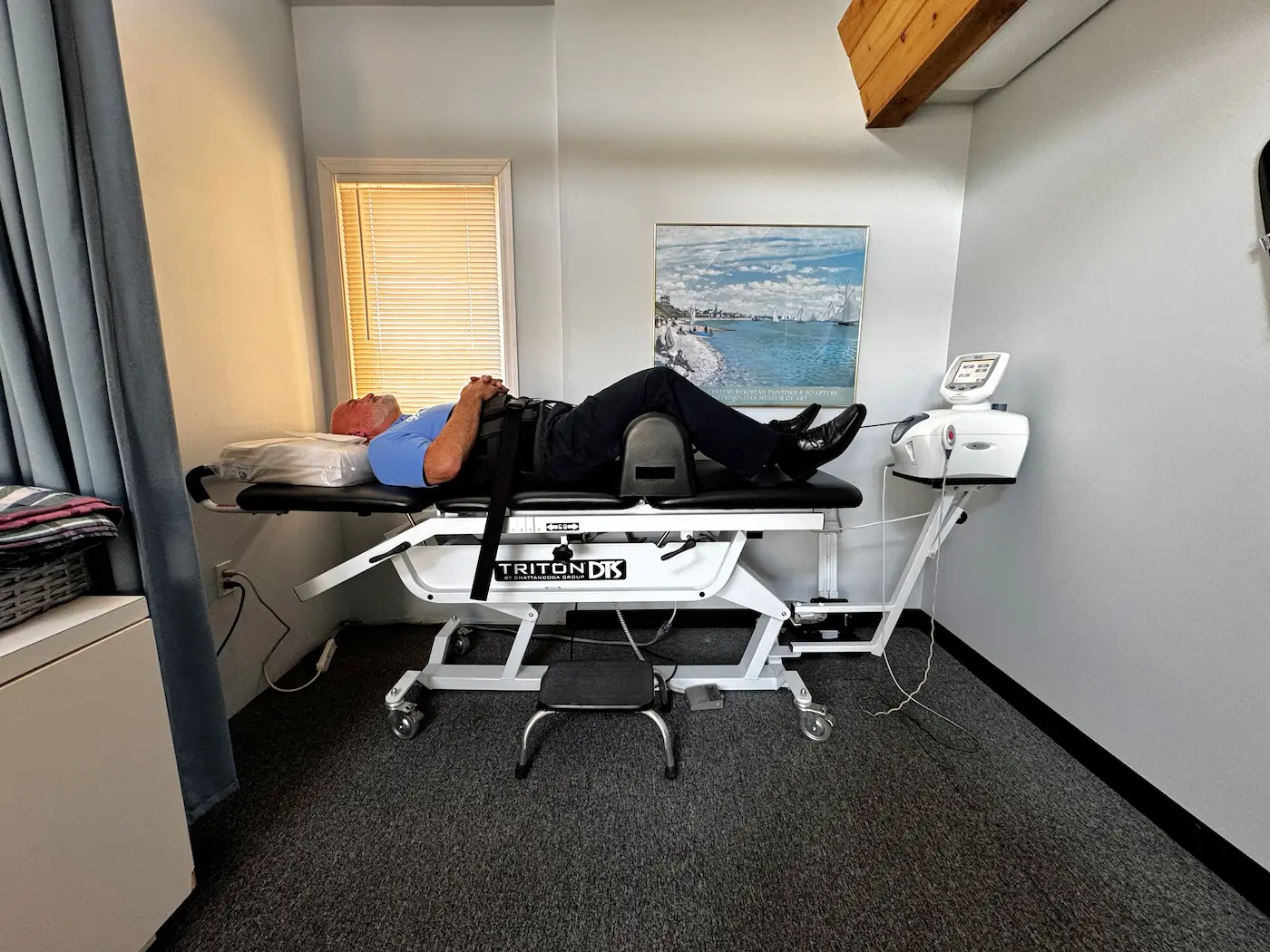
Spinal decompression uses a specialized table that applies controlled traction to the spine. Rather than relying on gravity, the table is programmed to target specific segments with a precise amount of force in a gentle, cyclical pattern.
That targeted pull can create negative pressure within a specific disc, which may help draw a bulging or herniated portion inward and ease pressure on the nearby nerve. The control is the whole point, since the treatment focuses on the level that needs it.
The Key Difference: Passive vs. Controlled
An inversion table applies a broad, gravity-driven stretch that you cannot fine-tune. Spinal decompression applies a specific, measured force to a specific area under clinical supervision.
Think of it as the difference between stretching your whole back and directing relief to the exact spot that hurts. For a disc problem at one or two levels, that focus matters, because a general stretch may barely reach the segment that is the real issue.
Where Inversion Tables Fall Short
Beyond the lack of precision, inversion tables have practical drawbacks. Hanging upside down raises blood pressure and increases pressure in the eyes, so they are not safe for everyone, particularly people with high blood pressure, glaucoma, heart conditions, or certain other issues.
They also rely on you to use them correctly and consistently, without professional guidance on whether inversion is even right for your specific condition. For a serious disc problem, that guesswork can be a real limitation.
What Spinal Decompression Adds
The clinical setting brings advantages an inversion table cannot. Before treatment, Dr. Oyler evaluates whether decompression is appropriate for your specific condition, since not every back problem is a candidate.
The treatment itself is controlled and adjusted to you, and it fits into a broader plan that can include other care aimed at the disc, the joints, and the surrounding tissue. That combination targets the problem from more than one angle.
Are Inversion Tables Ever Useful?
To be fair, inversion tables are not worthless. For someone with mild, general back tightness and no serious underlying condition, a short session can feel relieving, much like a good stretch.
The issue is expecting a home device to solve a real disc problem. Inversion may offer a temporary sense of relief while doing little for the specific level that is driving the pain, which can delay the kind of care that would actually help.
Which One Makes Sense for Disc Problems
For genuine disc conditions like a herniated disc or disc-related sciatica, the targeted approach of spinal decompression is generally the more suitable option. It focuses on the exact level rather than stretching everything and hoping the right segment gets relief.
An inversion table may still offer some general comfort for mild tightness. It simply is not designed to address a specific disc problem the way a controlled decompression program can.
Getting an Honest Assessment
The most important step is finding out what is actually causing your back pain before deciding on any approach. With more than four decades of experience, Dr. Oyler in Reynoldsburg evaluates whether a disc is the source and whether decompression is a good fit for you.
If it is not the right treatment, he will tell you and talk through other options, so you are not guessing with a device at home.
What Decompression Feels Like
People are sometimes nervous about the idea of traction, but spinal decompression is usually gentle and relaxing. You lie on the table, secured with a padded support belt, while the system applies and releases the pull in a slow, controlled rhythm.
Many people find the sessions easy, and some even find them relaxing enough to doze off. There is no hanging upside down and no pressure building in your head, which is a common concern with inversion.
How Many Sessions Does Decompression Take?
Decompression is done as a series rather than a single visit, since disc changes and tissue response take time. The exact number of sessions depends on the condition, its severity, and how you respond along the way.
Dr. Oyler recommends a specific plan after evaluating your situation, and the plan is adjusted based on progress. This is another area where a clinical approach differs from a home device, which offers no way to track or adjust based on how you are actually doing.
Why the Diagnosis Comes First
Back pain has many possible sources, and not all of them respond to decompression. Some pain comes mainly from joints, some from muscles, and some from a disc, and each calls for a different response.
An inversion table treats every back the same way, with a general stretch. A proper evaluation identifies what is actually going on, so the treatment fits the problem instead of hoping a one-size approach happens to help.
The Risk of Waiting Too Long
Relying on an inversion table for temporary relief can quietly delay real care for a disc problem. When the underlying issue is not addressed, symptoms can become more stubborn over time, and a problem that might have responded well early can grow harder to manage.
Feeling a little better in the moment is not the same as improving. If back or leg pain keeps returning despite time on an inversion table, that is a signal to have the actual cause evaluated.
If you are weighing an inversion table against professional decompression, we can help you understand which fits your situation. Contact Oyler Chiropractic in Reynoldsburg or call (614) 863-0111 to schedule a visit.